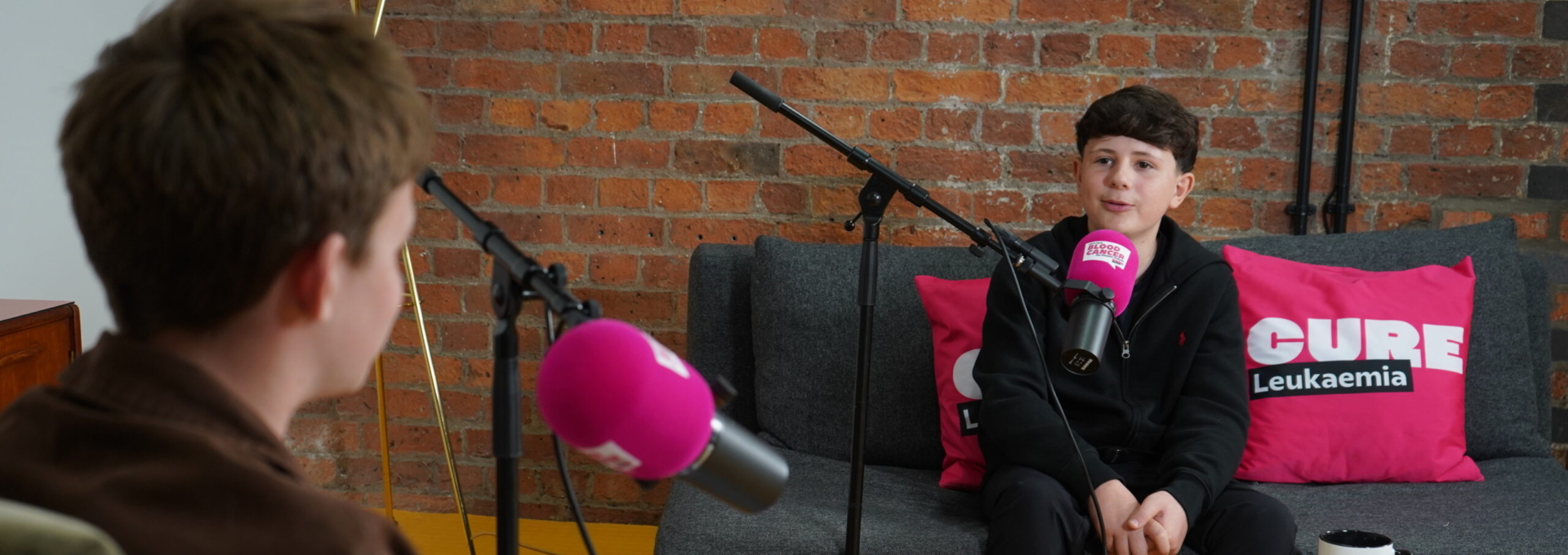
“I cried when I found out I could go back to school”
In the latest episode of Cure Leukaemia’s Let’s Talk Blood Cancer: The Patients Podcast, special guest host Hughie Higginson sits down with fellow childhood leukaemia survivor Jude Hawkridge to discuss their shared experiences of Acute Lymphoblastic Leukaemia (ALL).
Hearing about their diagnosis
Jude was just seven years old when he was diagnosed with ALL after beginning to feel unusually weak, “I couldn’t really play football anymore”. “It took around two weeks to find out what was wrong.”
Jude knew very little about cancer before his diagnosis, “the only thing I knew about cancer is that it can kill you. I only understood the word cancer.”
Hughie can immediately relate to Jude’s experience, having also been diagnosed with ALL after noticing unusual symptoms while playing football. “I was really tired and had aches and pains in my chest, back, knees and ankles”.
For Hughie, it took a few months to discover the cause of his symptoms was ALL, “it was in a piece of tissue between my bone and bone marrow, which made it hard to find”.
Going through treatment
Jude’s treatment began with chemotherapy, but when this wasn’t successful, he was referred to Manchester for CAR-T cell therapy.
“I had chemo first, which didn’t work. Then I had CAR-T. They took my blood out over two or three days and then froze it, a few months later they put it back in.”
Following CAR-T therapy, Jude underwent a stem cell transplant at Sheffield Children’s Hospital. After his older sister, Lily, was identified as his 10/10 donor match.
Both Hughie and Jude have undergone challenge of spending long periods in hospital. For Jude, one of the hardest things he found was people treating him differently. “I didn’t like it when people treated me differently because of it, a lot of my friends treated me the same, which I liked ”.
Jude also remembers finding comfort in the small things during his time in hospital, “when I was in hospital, I had a heated blanket which really comforted me.”
Like many children receiving treatment, both Hughie and Jude experienced a dramatic change in their appetite. For Jude, “one thing I missed was eating pizza”.
Instead of craving his usual favourite foods, Jude found himself wanting “ketchup sandwiches, Hubba Bubba chewing gum and BBQ Pringles,” while Hughie’s go-to craving became simple ham sandwiches.
Isolation became a significant part of both Hughie, and Jude’s treatments. Jude spent as long as three months isolated during his recovery, “I hated being trapped inside.” Unable to spend time with his friends, he would wave to them through the hospital window when they came to visit.
Hughie remembers another difficult aspect of hospital life. “You could swap which parent was with you every 2 weeks. Which didn’t make sense because you’re at one of the lowest points you’ve ever been and you can’t actually see your family.”
Being a kid again
Jude was 10 years old when he received the all clear, although he says treatment became harder as it progressed. One of his happiest memories was hearing he could finally return to school after missing all of Years 3 and 4.
“I started crying when I found out I could go back to school.” Looking back now, he reflects on how much he has overcome. “I look back on it and see how far I’ve come, but it was such a hard time.”
For Jude, football was one of the things he missed the most during treatment. “I missed football the most, going to watch Leeds and playing football on a Sunday.”
Since finishing treatment, Jude has even had the opportunity to train with Leeds United, and meet some of his footballing hero’s.
Looking ahead, he already has plans for the future, “in five years time I want to be mountain biking in Switzerland.”
Professor Rob Wynn
Professor Rob Wynn played a huge part in both Hughie and Jude’s leukaemia journey, having treated Jude, and overseeing Hughie’s care.
With Hughie describing Professor Wynn as, “like a hero”, and Jude thanking him for “helping me get back to who I was before”.
The future
Hughie and Jude reflect on how treatment will be improved for children, like them through the ATICUS Network.
The network aims to make treatments less toxic, more innovative clinical trials for children undergoing stem cell transplants.
The ATICUS Network means a lot to Jude, as for him ““It makes me feel good that other kids won’t have to go through what I did”.
For Hughie, the ATICUS Network is so special as it gives “more kids a chance to get better.”