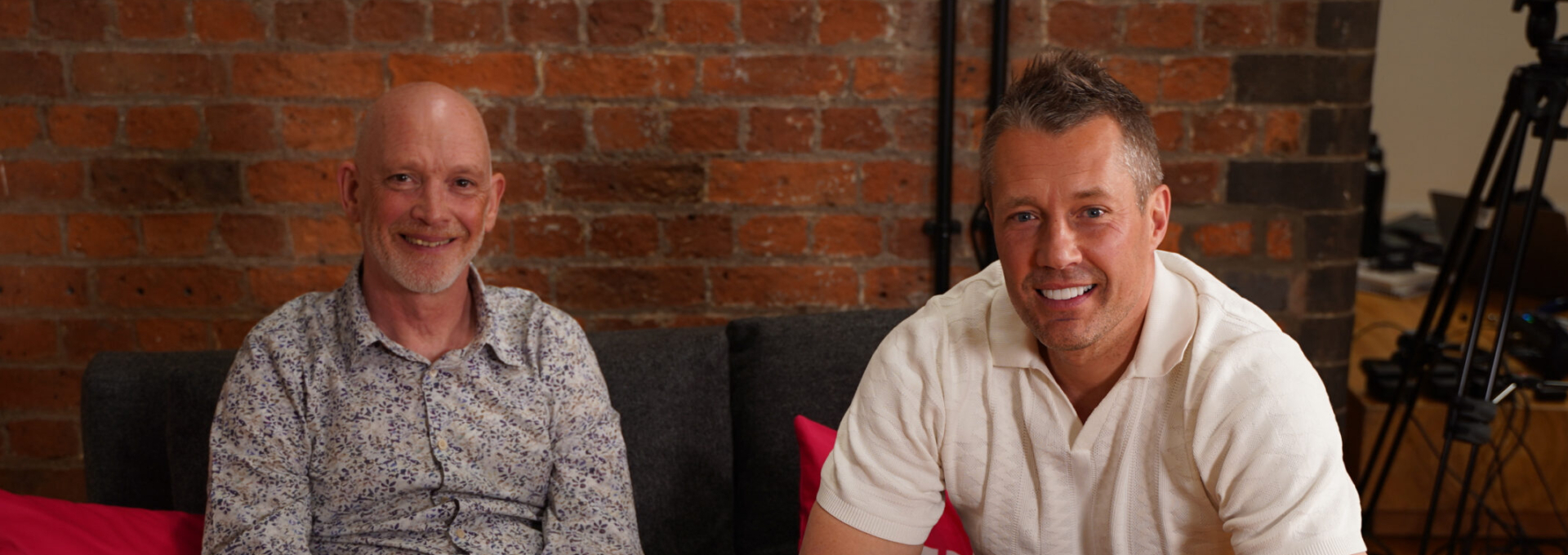
Professor Rob Wynn – “We Can Do More”
In the latest episode of Cure Leukaemia’s Let’s Talk Blood Cancer: The Patients Podcast, host Adam Joyce sits down with Professor Rob Wynn, Consultant Paediatric Haematologist and Director of Blood and Bone Marrow Transplantation at Manchester Children’s Hospital.
Why Haematology?
Growing up in Liverpool, medicine was not always the plan for Professor Wynn. “I wasn’t from a family of medics. It wasn’t until the first day of sixth form that I decided I wanted to do medicine.”
After studying at Cambridge and completing his medical training in London, he initially considered psychiatry before discovering a passion for haematology. “I always liked haematology. It combined the science of medicine and the philosophy of medicine.”
After working in adult medicine and paediatrics, he eventually specialised in paediatric haematology, a field he has dedicated his career to.
Changes in Haematology
Professor Wynn has witnessed remarkable progress in childhood blood cancer treatment over the past three decades. “We are lucky because we can be part of the change in medicine. It’s a different world to when I started.”
Advances in transplantation, targeted therapies and immunotherapies have improved outcomes for many patients. “We treat lots of kids and we cure most of them, but most isn’t enough.”
“Where chemotherapy fails, we have many more options now.”
What is Cord Blood?
A major focus of Professor Wynn’s work is blood and bone marrow transplantation, including the use of cord blood donations. Collected from the placenta and umbilical cord after birth, cord blood contains stem cells that can be used in transplantation.
“The cord blood contains the cells that will make blood for the rest of that child’s life.”
Research suggests cord blood transplants may be particularly effective in treating leukaemia.
“It seems to be better at curing leukaemia.”
Scientists are still investigating why, but early findings point to a strong immune response shortly after transplantation. “In the first few hours after a cord blood transplant, we see a lot of immune cells. These are cells which get rid of the cancer.”
As Professor Wynn explains, “the reason transplants work is the new immune systems reject the cancer cells.”
Common Misconceptions
One of the biggest misconceptions about childhood leukaemia is how successful treatment can be, “the majority of children are cured.”
For Professor Wynn, one of the most important responsibilities when speaking to families is balancing honesty with optimism.
“One of your first responsibilities is to give hope, and truth.”
His definition of a cure extends far beyond the end of treatment. “A cure means they are alive, well and their disease is gone so they can forget they ever had leukaemia.”
He often refers to the “school gates test”.
“You’re stood outside the school gates when your child is 13 and they had leukaemia when they were two. Can you tell they had leukaemia? Most of the time you can’t.”
The ATICUS Network
Alongside his clinical work, Professor Wynn is a passionate advocate for clinical research through the ATICUS Network.
“What we need is a national structure to open trials we think are good and to have them open all over the country quickly.”
The ultimate aim is clear, “to cure without toxicity and to cure everyone without side effects.”
His motivation remains rooted in the patients he has cared for throughout his career.
“I’ve seen kids where the treatments have worked, I’ve seen where the treatments are too toxic and I’ve seen where kids have relapsed. That’s the motivation.”
Taking on Tour 21
Away from the hospital, Professor Wynn has also supported Cure Leukaemia through fundraising challenges.
In 2021, he joined Tour 21, cycling the entire Tour de France route one week before the professionals.
On the second day, he crashed and broke his elbow. Despite the injury, he completed the remaining 18 days of the challenge. His determination on the bike reflects the same resilience that has defined his career in paediatric haematology.
For Professor Wynn, the goal remains simple: continue improving treatments, reducing side effects and giving every child diagnosed with blood cancer the best possible chance of a cure.