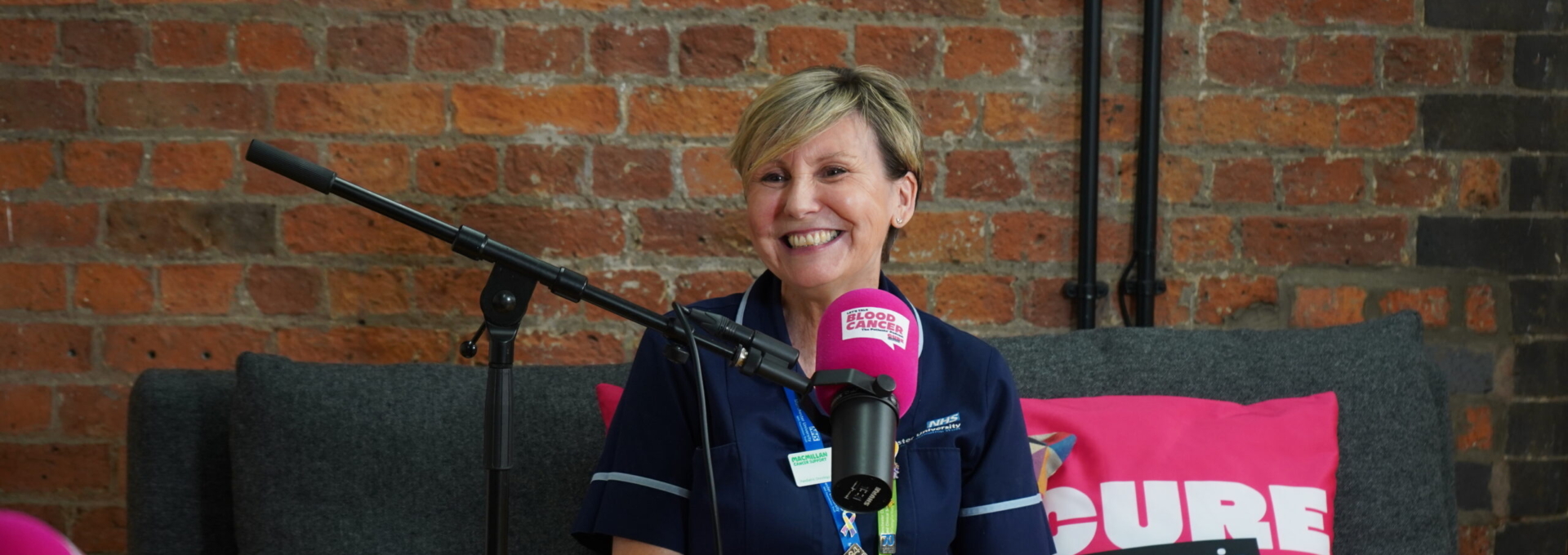
Andrea – “You’ve seen things no child should see”
In the latest episode of Cure Leukaemia’s Let’s Talk Blood Cancer: The Patients Podcast, special guest host and childhood Leukaemia survivor Hughie Higginson sits down with, Andrea. A Macmillan Nurse whose role is dedicated to helping families like Hughie’s navigate one of the most difficult experiences imaginable – a childhood cancer diagnosis.
Why Nursing?
For Andrea, the job is about far more than medicine. It is about giving families confidence, helping them regain a sense of control, and guiding them through every stage of their journey.
After beginning her nursing training in 1986, Andrea initially trained in adult nursing before moving into paediatrics. She completed specialist children’s training at Great Ormond Street Hospital (GOSH) in London and quickly discovered where her passion lay.
“I loved paediatrics because you get everything. You get complex medicine, but you also get the privilege of working with children and families.”
Andrea has been a nurse for 34 years and now works in Manchester, supporting children and families affected by cancer.
Finding her calling in Oncology
Andrea never set out to become an oncology nurse. “You develop into a role like this rather than choose it”.
While working as a ward sister, she realised there was more she wanted to offer patients and families beyond clinical care. “There are so many facets to it – education, counselling, medicine, family support. I wanted to be involved in all of it.”
For Andrea, cancer care is the ultimate team effort, “everyone works together. We are like a jigsaw puzzle that pulls together to help these families.”
Despite the challenges of the role, her favourite part remains unchanged. “My favourite part of the job is working with children.”
Meeting Families on their Worst Day
Andrea often meets families on the worst day of their lives. For Hughie, his family was going through the worst when he first met Andrea. She was both the first and last nurse he saw during treatment. There for him when he was first diagnosed and again when he finally rang the bell to mark the end of his journey.
Reflecting on those first moments after diagnosis, Andrea says the emotions are remarkably similar for every family. “Like all families who walk through our doors, there is massive fear. Everyone looks frightened and doesn’t know what to do next.”
The first step is helping families understand what is happening and what comes next. “It’s about teaching you what is going on and doing it in the way that works best for you.”
As the days pass and families begin to settle into life on the ward, relationships quickly deepen, “within two weeks, we begin to see the real people behind the family. You get used to the ward, you’re sleeping there, and suddenly we start getting to know each other properly.”
Helping Children get through it
One of the greatest rewards of Andrea’s work is seeing children recover and thrive, “it’s a privilege to see children come out the other side.”
At the same time, she acknowledges the harsh reality of what young patients experience. “They see things no child should see and learn things nobody should have to learn, especially at that age.”
Her role is to help children and families navigate those experiences without losing sight of who they are. “It’s all about helping you get through it all so you can be a normal person at the end of it.”
Explaining Cancer to Children
One of the most difficult parts of the job is helping children understand cancer in a way that is not frightening.
Hughie remember exactly how his diagnosis was explained to him in a way in which he could understand. “I was told, your body is like a garden that has been overrun by weeds. We need to use weedkiller to get rid of the weeds so the flowers can grow back.”
By breaking complex medical concepts into everyday language, children quickly gain confidence in their understanding.
For Andrea, preparing families for challenges ahead is a key part of her role, “our job is to shine the light on upcoming hurdles. ”But this can’t always be done in the same way for each child.
Andrea believes children often communicate best through play rather than direct conversation “It’s important to use different techniques to help children open up and feel safe enough to say how they feel.”
Whether it is games, creative activities or simple moments of fun, these approaches often allow children to express emotions they may struggle to put into words, but “support can never come from one person alone, it takes a village”.
Sometimes the smallest interventions can make the biggest difference. If Andrea notices someone struggling, she often implements what she calls a “hug an hour.”
“I’ll say, ‘Right, I’m putting you on a hug an hour.’”
This consists of regular check-ins, reassurance and support throughout the day, but for Andrea’s patients she “can see their improvement throughout the day.”
Hughie’s Experience
Having being treated throughout the COVID-19 pandemic, Hughie was unable to see one thing in particular on the ward, “the nurses smile”. Andrea found a way to combat this, Butterfly Kisses, fluttering your eyelashes to show emotion and affection.
“It’s all about making people smile and making them feel safe when they do that”, this simple gesture became a reminder that connection is possible, even in the most difficult circumstances.
Leaving Work at Work
After decades in paediatric oncology, Andrea has developed ways to protect her own wellbeing,“it’s all about mindfulness.”
“If I become too close and too invested in a family, then I cannot help them because I’m no longer approaching things from a nurse’s point of view.”
One strategy is a simple mental transition she makes during her daily commute. “On my drive home there’s a billboard I pass. Once I pass it, I go into home Andrea mode. When I drive back into work and pass it again, I begin to think about work.”
The separation allows her to be fully present in both parts of her life.
“You have to keep it professional. You can go from one family who has just received the worst news imaginable to another family who are finishing treatment and celebrating.”
She never wants either family to carry the emotional weight of the conversation before or after theirs.
A Message to Families
It is something I say to all families, “first of all, I’m so sorry you’re here, but welcome to the ward family.”
She wants families to know they are not facing the journey alone. “You are at the right place at the right time, and I’m the shining light helping to direct you through this journey.”
The learning process comes in a layered approach as to not overwhelm families. “We start with the treatment and what is going to happen. Then we talk about things like work, mortgages, being away from home and the support available.”
Most importantly, she encourages families not to feel overwhelmed by the vast amount of information they are about to receive. “It’s all about layered learning and not trying to learn the language in the first hour.”
Over time, knowledge builds naturally through conversations with nurses, doctors and other families who understand exactly what they are going through.
“If another parent asks you to have a coffee with them, have that coffee.” Because, as Andrea has seen countless times throughout her career, the support one family receives today often becomes the support they offer another family tomorrow.