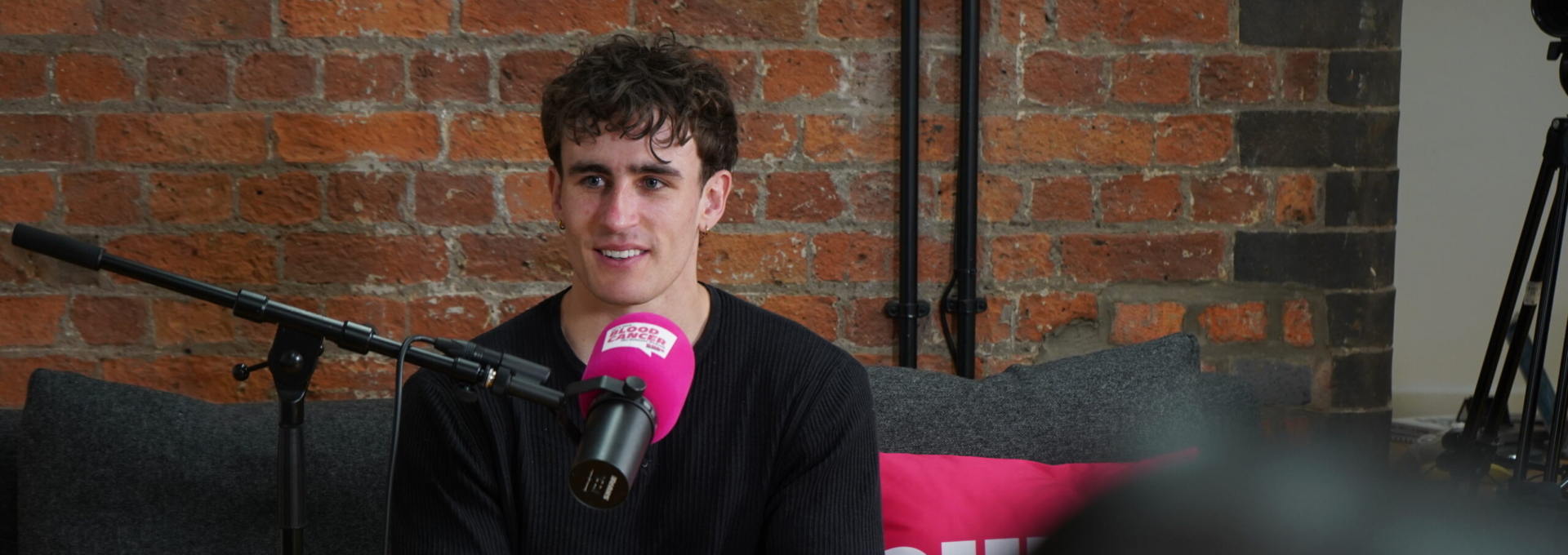
Dr. Tom Hunt – “We’re at Endgame if this doesn’t work”
In the latest episode of Cure Leukaemia’s Let’s Talk Blood Cancer: The Patients Podcast, host Adam Joyce sits down with with Tom Hunt, a junior doctor whose life changed drastically when he was diagnosed with Acute Lymphoblastic Leukaemia (ALL) at just 18 years old.
The First Signs
Looking back, Tom can now recognise the subtle warning signs that appeared months before his diagnosis. “All the way through the summer I was finding little lumps on my neck.”
At the time, life was busy. He was working on his families farm, starting shifts at 8am before staying out with friends until 3am. Feeling increasingly tired, he assumed he was simply suffering from late nights and hangovers.
“I was feeling more hungover.”
After booking an Inter-railing trip around Europe, things became harder to ignore, “I was in bed for 18 hours a day.”
While travelling through Prague, he found himself unable to enjoy the experience, “I couldn’t motivate myself to do anything.”
When he returned home on a Saturday evening, he booked an appointment with his GP for the Monday and was prescribed antibiotics, assuming it was a simple infection.
His Diagnosis
The following day, while collecting his younger sister from Brownies, Tom bumped into one of his mum’s friends, a knee surgeon. He asked Tom to see if he could get a GP appointment for the following day, and if not he would take some bloods for him.
Early the next morning, blood tests were taken so they could reach the laboratory quickly.
At 3pm, the phone rang.
“‘Can you come in for a chat?'”
Initially, doctors confirmed he had glandular fever, but there was another, far more worrying result. “‘You’ve got glandular fever, but you also have no blood counts.'”
For the first time, the word leukaemia was mentioned.
Although swollen lymph nodes had led doctors to consider leukaemia or lymphoma early on, Tom never believed it could apply to him. “I thought, ‘No way it could be that.'”
He was sent to a side room in A&E before being transferred to the Acute Medical Unit.
“They said, ‘We’re going to do a load of tests to see what’s wrong with you.'”
After the tests, Tom was keen to go home rather than wait around for results. “Five minutes later, about 20 doctors and nurses came into the room. The news came immediately.”
“They told me there and then they thought it was probably acute lymphoblastic leukaemia.”
“I remember crying for about 20 minutes.”
Once the initial shock had passed, Tom’s mindset quickly shifted.
“Within half an hour they’d given us all the information and I just said, ‘Well, can we just get started then?'”
Doctors explained he would be transferred to The Christie the following day, with treatment due to begin on Monday. Tom wanted to start immediately.
Facing Treatment
One thing that helped Tom was the positive attitude he had from the moment he was diagnosed.
“The second they told me, I thought, ‘I’m going to be fine.'”
After being warned the first week of chemotherapy would be the worst, Tom realised all to quick this was most definitely the case, “the first three days were the brutal part, everything in my body hurt”.
When doctors returned the following week for the next round of chemotherapy, Tom reached breaking point.
“I said to my mum, ‘I can’t do it.'”
Tom’s mums response has stayed with him ever since. “‘You haven’t got a choice, mate.'”
For Tom, one of the darkest moments came just before his birthday.
“I said to Mum, ‘Can you stay tonight? Something feels off.'” That night, Tom suffered the only seizure of his entire treatment.
The Importance of Support
Being diagnosed at 18 meant Tom was surrounded by friends from school, many of whom stayed in close contact despite leaving for university.
“I had so much support.”
His mum became his constant throughout treatment, accompanying him to every hospital appointment, “they got me through it.”
Looking back, he feels being diagnosed later in life may have been a very different experience.
“I think it would be different now because I have a much smaller circle.”
Life in Remission
Tom completed the most intensive part of his treatment in just seven months before reaching remission.
“Remission means there is no detectable disease.”
However, treatment didn’t end there. He continued taking maintenance medication for a further two years. “Even though you’re in remission, it will always be in the back of your mind.”
Coming Full Circle
Long before his diagnosis, Tom had decided he wanted to become a doctor, “I decided when I was 15 that I wanted to study medicine.”
In a coincidental twist, the day Tom was diagnosed, 15th September, was the very day he would have started medical school, had he not deferred his place.
Following treatment, he returned to university, completed his medical degree, got back into the gym and reconnected with friends.
Now working as a junior doctor, Tom believes his own experience has shaped the way he cares for patients.
“Nurses and porters tell me it’s because I don’t just speak to people about work.” Instead Tom has build genuine relationships with the colleagues and patients around him.
The After Effects of Diagnosis
Although treatment ended, the emotional impact remained. Tom found himself constantly worrying that every ache or bad day meant his cancer had returned.
“I was using the gym as a way of coping, but if I had a bad session I’d worry I wasn’t well.” The anxiety eventually developed into panic attacks, leading him to seek therapy, “the first four sessions were just having a chat.”
Then something changed, “in session five, I walked out feeling like a totally new person.”
A New Perspective
Living through blood cancer has transformed the way Tom approaches life. “It makes you realise things just aren’t that deep, and it’s all about remembering that the good days will start to outnumber the bad days.”