Mark Chandler – “I hosted my own goodbye party”
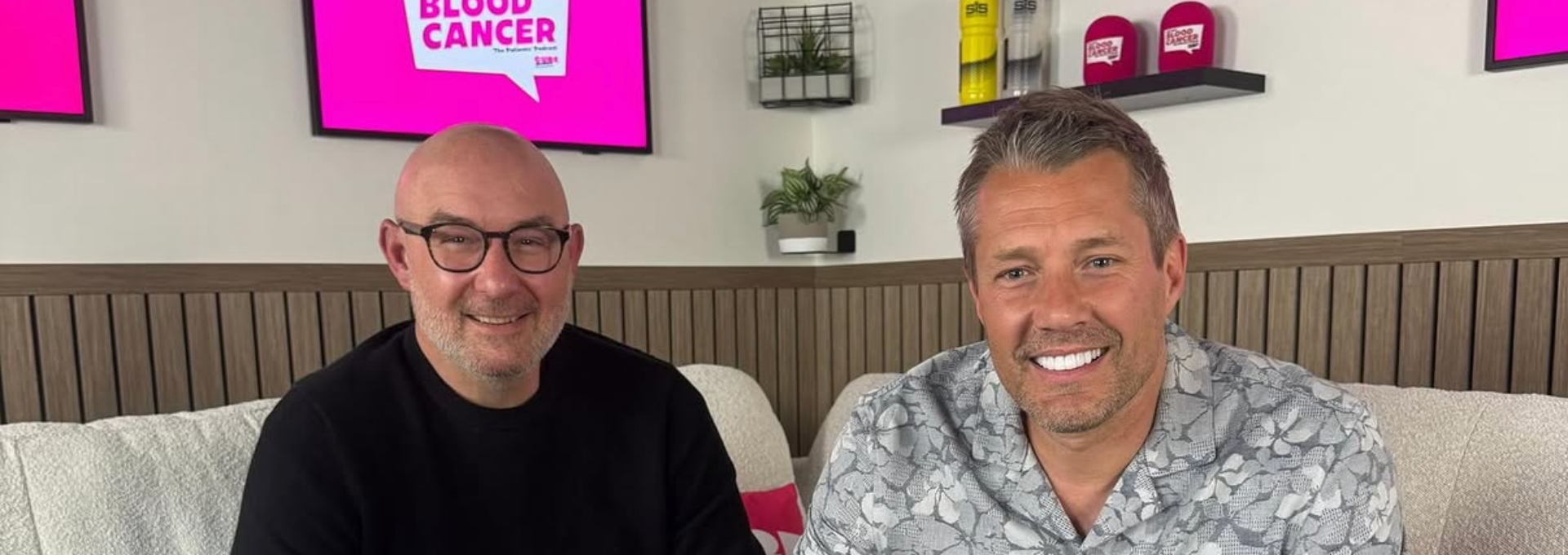
In the latest episode of Cure Leukaemia’s Let’s Talk Blood Cancer: The Patients Podcast, host Adam Joyce sits down with, Mark Chandler, a father-of-three whose life was turned upside down when he was diagnosed with Acute Myeloid Leukaemia (AML).
Life Before Diagnosis
Before his diagnosis, Mark describes himself as a healthy, active person living a busy family life. He was running a business, taking family holidays, playing golf and coaching his son’s rugby team.
“I’ve never really been an unwell person.” Nothing about his lifestyle or health suggested what was about to happen.
The First Signs
The first symptom appeared after a few rounds of golf when Mark “ felt a pain across my shoulders.”
At first, Mark thought little of it. He attended a football match on the Saturday and coached rugby on the Sunday as planned. But by the end of the weekend, something wasn’t right. “I was just shivering and shaking.”
Despite feeling increasingly unwell, he continued working. On Monday, he found himself sitting under a blanket between Zoom calls. By Tuesday, while meeting with a client, he was struggling to hold a conversation on the phone. Recognising something was seriously wrong, he called his GP on Wednesday morning.
“They told me I needed to go to A&E.”
Several hours later, doctors suspected a blood clot on his lung and raised the possibility of lung cancer. The following day, a CT scan ruled out both conditions. However, Mark tested positive for Covid-19 and was told he would be transferred to a specialist ward.
At the time, he had no idea it was the haematology ward, for Mark this was “totally out of the blue.”
Looking back now, he still struggles to identify any warning signs. “I understand more about leukaemia now and the symptoms that would show, and none of that was present. Looking back at photos from our holiday, I wouldn’t be able to tell.”
An Unexpected Diagnosis
While waiting on the ward to be seen, Mark fell sleep, “when I woke up, there was a drip stand beside me that said ‘Cancer Services’ on it.”
Concerned, he questioned a nurse, who reassured him it had simply been borrowed from another department. A few days later, following a bone marrow biopsy, Mark received his diagnosis.
Acute Myeloid Leukaemia.
“My first thoughts were about my children and my wife. I knew I would be fine.” Mark remembers the harness of delivery from his consultant following his diagnosis, “he told me it was a terrible, terrible disease.”
For Mark, that was exactly what he needed, “if I hear it how it is, then I can prepare my mind to deal with it.”
Breaking The News To Family
Alongside processing his own diagnosis, Mark and Stina faced the challenge of explaining cancer to their three children. Oscar was 17, Jacob was 12 and Luna was just 3 years old.
“Three children with three different ranges of emotions and ways of understanding.”
The demands of supporting their children left little time for the couple to process the diagnosis themselves, “I got to grips with it because I knew I wouldn’t fight it if I was fighting myself.”
Running Out of Options
Mark began standard chemotherapy soon after diagnosis, but the treatment failed to control the disease.
Doctors escalated treatment and administered the strongest chemotherapy available in an attempt to reduce his blast count to below 5%, making him eligible for a stem cell transplant.
On 12 December 2024, Mark was told his blasts appeared to be below the required threshold. The following day, Mark’s hope disappeared.
“Your blasts are 7%”, at this point a stem cell transplant was no longer possible. After failing two rounds of chemotherapy, doctors presented Mark with three options.
1.Another round of intensive chemotherapy, despite warnings that his body was so weak there was a high probability he would die during treatment.
2. A tablet-based treatment more commonly used for slower-growing cancers, although doctors believed it would have little impact on his aggressive AML.
3. To go home and spend time with family.
“They told me I had two to four weeks left, so I chose option 3″, spending what he believed would be his final weeks with his family.
“I wanted to put on a brave face for my kids, but I would break down as soon as I got into bed at night.”
Saying Goodbye
Faced with an uncertain future, Mark and Steena decided not to wait any longer to get married.
Steena arrived at the hospital one Friday morning expecting Mark to have a routine blood test. Instead, she was told they would be getting married that afternoon.
Hospital staff transformed the ward for the occasion, Mark’s nurses lined the aisle with Christmas trees collected from around the hospital. One nurse bought a cake, while his consultant’s wife lent Stina her wedding veil and insisted she keep it.
Just hours later, surrounded by family and hospital staff, they were married. Then, on Boxing Day, Mark organised something equally significant, messaging all of his friends and initiating them to the local pub.
“The purpose of the party was to say goodbye. It was a celebration of life.”
Everyone understood why they were there, despite the occasion, Mark chose not to drink alcohol. “I wanted to remember everything and be the last person to leave.”
The Miracle
As January arrived, Mark and Steena focused on creating memories with their children, filling their days with family experiences, determined to make every moment count.
Then four weeks passed, and Mark was still there.
Concerned but hopeful, Stina arranged another appointment with the hospital. “When we arrived they said, ‘We didn’t expect to see you.’”
Doctors were surprised to see that Mark had gained weight and appeared healthier than before.
He was offered injectable chemotherapy from February to May in the hope of extending his life by a few months.
Instead, it became the beginning of an extraordinary turnaround.
One Last Chance
In May, Mark was referred to King’s College Hospital, there, a consultant proposed a much more aggressive treatment approach.
“You know you’re dying, so if it’s alright with you I’d like to take a more experimental approach.”
The treatment combined injectable and tablet chemotherapy, again Mark received another blunt warning from his consultant. “This will send you to hell and back physically and mentally. But it may get you to a stem cell transplant.”
For Mark, the decision was immediate, the purpose of the treatment was ultimately to “ to bully my body with chemotherapy to get me to a stem cell transplant.”
Over the following four months, Mark spent long periods in hospital isolation. “The chemotherapy hammered me.”
Despite the brutality of the treatment, it worked.
His blast count fell from 40% to 3%. Doctors then recommended another round of chemotherapy to eliminate the remaining cancer cells completely.
But when the results came back, there were no detectable cancer cells. For the first time, a stem cell transplant became possible.
The Long Awaited Stem Cell Transplant
A donor search led by Anthony Nolan identified a 28-year-old man in Chile willing to donate his stem cells, his donation contained 5.2 million stem cells.
After everything Mark had endured, the transplant itself felt surprisingly simple, “It took around 40 minutes and felt almost anti-climactic.”
Following his 100-day bone marrow biopsy, doctors delivered the news he had been waiting to hear.
On 30th December 2025, Mark was told he was officially in remission.
Looking Forward
Although remission marked the end of one chapter, Mark says the experience has completely changed how he views life. “The mundane things are where the happiness is.”
Today, he focuses on being present with his family and appreciating the moments he once overlooked, “I was there, but I wasn’t there.” Now, he says, life is about slowing down.
Watch Mark’s podcast episode in full: