Professor Steve Knapper – Research Nurses Are The Glue Which Hold These Trials Together
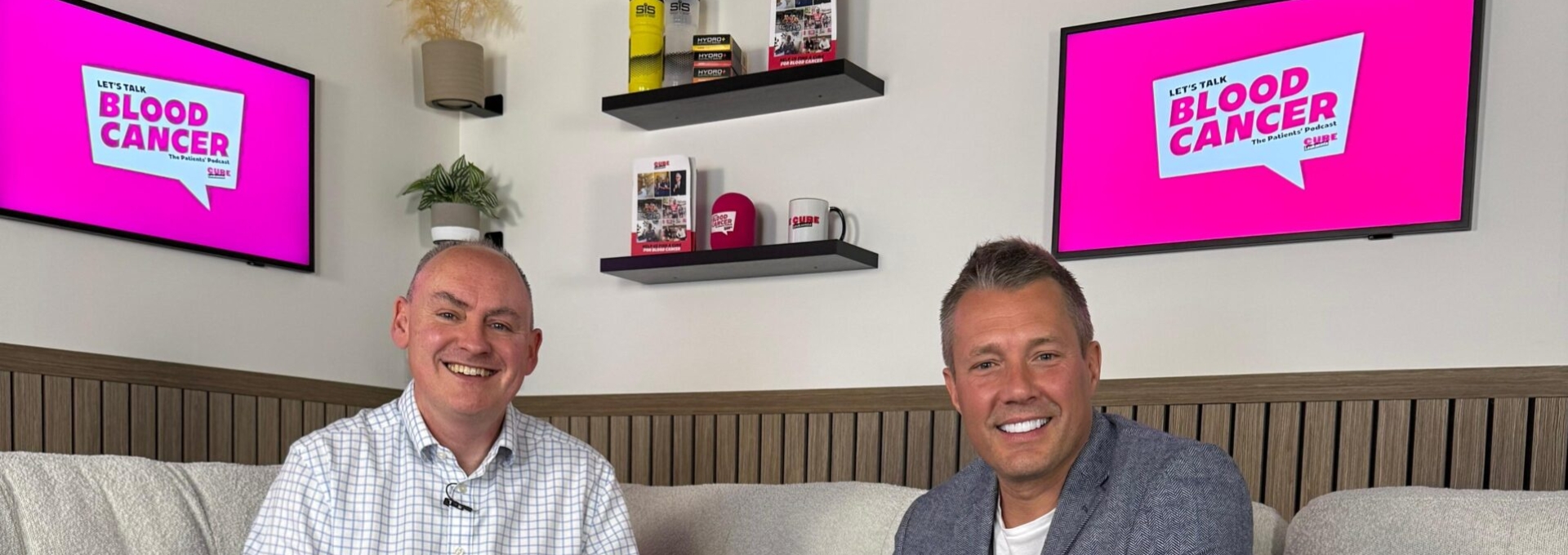
In the latest episode of Cure Leukaemia’s Let’s Talk Blood Cancer: The Patients Podcast, host Adam Joyce sits down with Professor Steve Knapper, Consultant Haematologist at the University of Wales Hospital, who specialises in Acute Myeloid Leukaemia (AML).
Why Haematology?
Following his medical degree, Professor Knapper worked at a hospital in Taunton as a Junior Doctor, at which time he undertook his medical rotation.
During this time, Junior Doctors are introduced into several different specialised fields to get a sense of what they may choose to specialise in. After his 4-month-long Haematology rotation (which happened to be his last), Professor Knapper took to it “like a duck to water” and instantly knew it was the field in which he wanted to specialise.
Acute Myeloid Leukaemia
There are 100’s of different types of blood cancers, each with its own gene mutations. Blood cancers are commonly split into ‘Chronic’ or ‘Acute’. Acute means the cancer “has formed quickly and quite dramatically,” whereas Chronic cancer forms over time.
All blood cells begin as a blast, which will then become red or white blood cells or platelets. AML occurs when there is a block in the blast. Therefore, no red or white blood cells or platelets are being produced. There are only blasts, which do not protect a patient from anything.
How does the TAP work?
Professor Knapper has been involved with the Trials Acceleration Programme (TAP) for more than a decade. The TAP was initiated due to a lack of coordination between different Haematology centre’s and their use of clinical trials.
As a result of the TAP, there are now 15 centralised centres that can open the same clinical trial in a much more coordinated way – leading to greater recruitment of trials and early trial activity.
Each trial “comes in all shapes and sizes”, but is commonly divided into 4 phases. Phases 1 and 2 are ‘the early phase’. During the early phase, drugs will be issued to a small number of patients; in most cases, these will be patients who have exhausted all conventional treatments.
The TAP aims to keep as many trials open as possible, to give as many patients the best outcome as possible.
What is a Research Nurse?
Professor Knapper described funded research nurses as “the glue which holds clinical trials together”. The role of these nurses is to be the lead on a clinical trial in their centre, without which “these trials wouldn’t function”.
Changes in Haematology
Professor Knapper attributes the introduction of initiatives like the TAP to the enhancement in clinical trials for patients. “Over the last 5 years, we have had 7 or 8 new drugs approved in the AML field in particular.
The introduction of these new drugs has allowed the division between ‘intensive’ (toxic chemotherapy with the aim of a long-term cure) and ‘non-intensive’ (palliative medication to control in the short term) to be lessened.
New regimens have enabled a mix of both routes; now, non-intensive treatments can be used in combination to begin to control for the long term.
Professor Knapper is excited about the growth within this field and the possibility of helping more AML patients. With the only area of the ‘system’ he would wish to improve instantly being the access that patients in more remote areas have to clinical trials.
Fundraising
Highlighting the importance of fundraising, Professor Knapper highlights “we wouldn’t be able to do what we do without the charitable contributions”. The importance of charities like Cure Leukaemia who are bringing people together in the same room to work together to achieve a shared goal.